

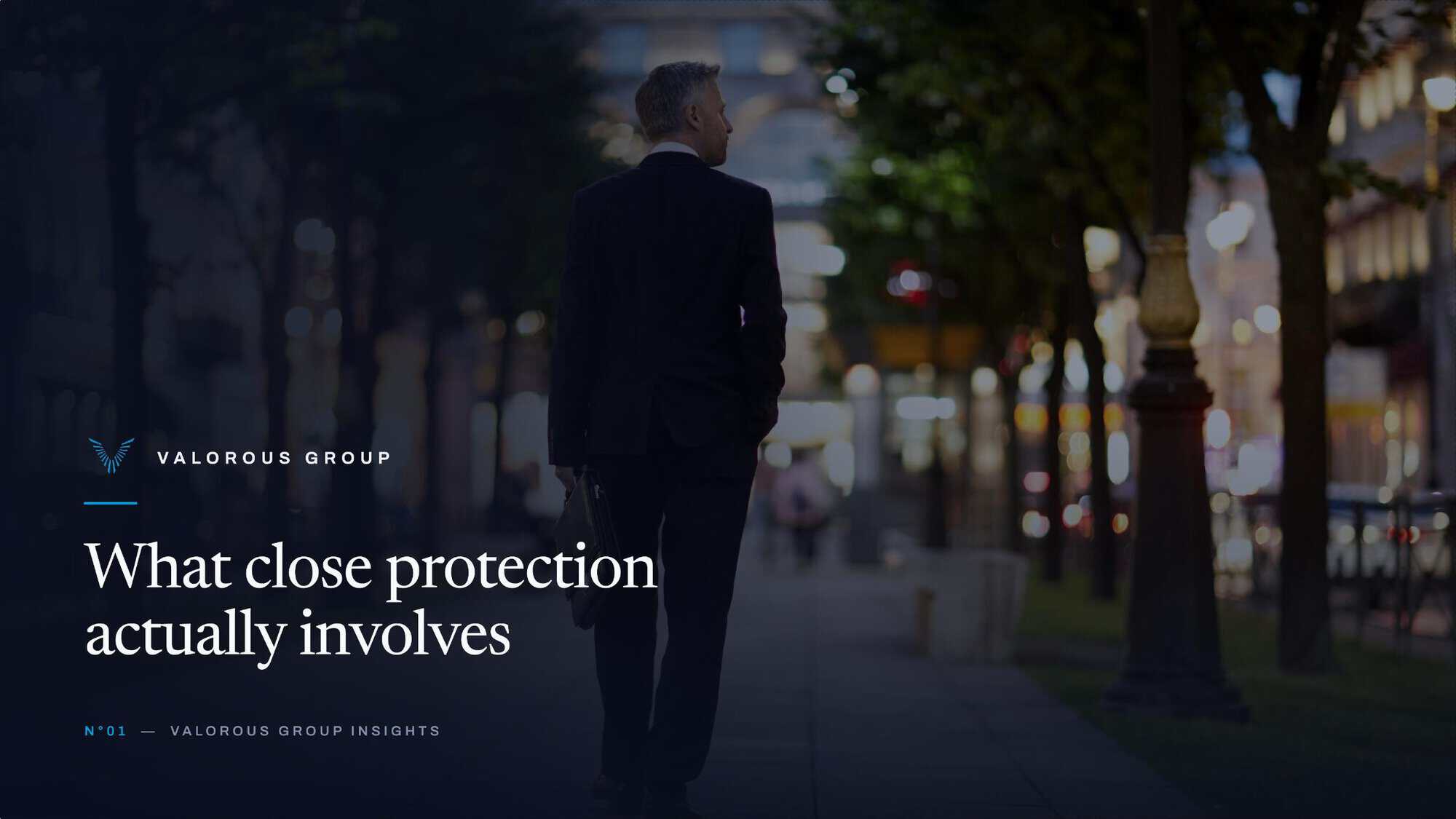
Close protection is the professional safeguarding of an individual, known as the principal, by trained and licensed operatives. It involves threat assessment, advance reconnaissance, route and journey planning, and a discreet protective presence around the principal’s daily life. In the United Kingdom, close protection operatives must hold a Security Industry Authority licence, and reputable firms assess risk before proposing any arrangement.
Most people encounter close protection through film and television, where it is portrayed as a wall of dark suits and visible force. The reality, at least when it is done properly, is almost the opposite. Good close protection is quiet, considered and largely invisible. Its purpose is not to signal importance but to remove risk, friction and uncertainty from the principal’s life so completely that, on most days, nothing appears to happen at all.
This guide explains what close protection actually involves, how it is planned, how operatives are selected, and what a first-time principal or family office should expect from a professional engagement.
What does a close protection operative actually do?
The public image of close protection is reactive: a person who intervenes when something goes wrong. In practice, the discipline is overwhelmingly preventative. A competent operative spends the great majority of their time ensuring that nothing goes wrong in the first place.
Day to day, this means anticipating rather than responding. The operative arrives before the principal does. They know the building, the exits, the parking arrangements and the people expected to be present. They manage arrivals and departures so that the principal never waits exposed at a kerbside. They read environments continuously, noting who belongs and who does not, and they adjust plans quietly when circumstances change.
The measure of good close protection is not how dramatically an operative reacts to an incident, but how rarely an incident is allowed to develop. A well run protective detail feels, to the principal, like exceptional logistics: journeys run to time, venues are ready, and complications are resolved before they become visible.
What happens before an assignment begins?
No serious protective engagement begins on the day the operative arrives. Three strands of preparation come first.
The foundation is the threat and risk assessment. Before anything is proposed, the protective requirement must be understood: the principal’s profile and pattern of life, any known concerns, the family’s residences and routines, travel plans, and the exposure created by business interests or public visibility. This assessment determines the shape and scale of the protection, and it is revisited throughout the engagement as circumstances evolve.
The second strand is advance reconnaissance, often called the advance or the recce. Before the principal attends a venue, a member of the team visits it, or studies it in detail, to establish access points, secure holding areas, medical facilities, and the practicalities of arrival and departure. The principal walks into an environment that has already been assessed.
The third strand is route and journey planning. Every significant journey has a primary route, alternatives, and identified safe locations along the way. Timings are planned to avoid predictable patterns where the risk picture requires it. When these strands are done well, the visible part of close protection, the operative beside the principal, is simply the final layer of a much deeper structure.
What are the levels of visibility?
Close protection is delivered along a spectrum of visibility, and choosing the right point on that spectrum is a professional judgement, not a matter of taste alone.
Overt protection is deliberately visible. It is appropriate where deterrence itself is the objective, for example at certain public events or where a specific and acknowledged threat exists. Its presence sends a clear signal.
Low profile protection, by contrast, is designed to be unremarkable. Operatives dress and behave in keeping with the principal’s environment, whether that is a boardroom, a school gate or a family holiday. To an observer there is nothing to see, yet the same planning, positioning and readiness are in place.
For most UHNW principals and families, particularly in London, the low profile model is the correct choice. Visible security can draw precisely the attention it is meant to deflect, and it sits poorly with a private life. Discretion is not a compromise on safety; delivered properly, it is the more sophisticated form of it.
How are operatives selected and vetted?
The quality of close protection rests entirely on the quality of the people delivering it, which is why selection and vetting deserve close scrutiny from any prospective client.
In the United Kingdom, every close protection operative must hold a close protection licence issued by the Security Industry Authority. That is the legal baseline, not the standard. At Valorous Group, our operatives are SIA licensed as a matter of course, screened and vetted in line with BS 7858, the British Standard for security screening, and trained in first aid to a level appropriate to the role. Most come from careers in the military or police, where judgement under pressure was tested long before they entered the private sector, and all are selected as much for temperament as for capability. An operative who will spend long hours close to a family must be composed, courteous and unobtrusive.
Clients are entitled to ask about all of this. A professional firm will answer readily; hesitation on licensing or vetting should end the conversation.
How does close protection fit with residential security, security drivers and intelligence?
Close protection is one layer of a wider protective picture, and it performs best when the layers are designed together.
Residential security protects the places where the principal is most predictable: home, and often a country property or overseas residence. Security drivers manage the journeys between them, since the vehicle is where many principals are at their most exposed. Intelligence work sits beneath everything, monitoring the online environment, assessing emerging concerns and informing the threat picture on which all other decisions rest.
When these functions are procured separately, gaps appear at the seams: the driver who does not know the route plan, the residential team unaware of a concern the protection team is managing. Valorous Group operates as an integrated practice precisely to close those seams. Close protection, residential security, secure transport and intelligence are delivered under one governance structure, with one point of accountability. We are certified to ISO 9001:2015 and are an Associate Member of the Association of Security Consultants, and we regard that framework of standards as inseparable from the service itself.
How much does close protection cost in London?
It is a fair question, and the honest answer is that cost follows the requirement, not a rate card. Several factors set it.
The scope matters first: protecting an individual differs from protecting a family across several residences and schools, or securing a single high profile event. Team size matters: some requirements are properly met by a single experienced operative, while others need a team working in rotation to remain effective. The pattern of work matters: static coverage at a residence, a travelling detail accompanying international movement, and short notice event support are each resourced differently. Duration and notice period complete the picture.
What we would caution against is any firm that quotes a price before it understands the risk. A professional practice conducts a threat and risk assessment first, then proposes a structure proportionate to it. Anything else is guesswork sold with confidence. Once the requirement is defined, costs can be set out clearly and reviewed as circumstances change.
Frequently asked questions
Are your operatives SIA licensed?
Yes. Every Valorous Group close protection operative holds a current SIA close protection licence and is screened in line with BS 7858. Licensing is the legal minimum in the United Kingdom, and our own selection standards sit well above it.
How quickly can a team be mobilised?
For urgent requirements we can typically field an initial protective capability at short notice, with a fuller assessment following in parallel. For planned engagements, we prefer sufficient lead time to complete the threat assessment and advance work properly.
Do you operate internationally?
Yes. We support principals travelling from London across Europe, the Middle East and further afield, providing travelling protection teams, secure ground transport and destination reconnaissance through our own personnel and vetted international partners.
Is close protection discreet?
It can and usually should be. Most of our work is deliberately low profile, with operatives who blend into the principal’s professional and family environments. Overt protection is available where the threat picture genuinely calls for it.
A confidential conversation
If you are considering close protection for the first time, the most useful next step is not a brochure but a conversation. A short, confidential discussion allows us to understand your circumstances, explain what a proportionate arrangement would look like, and answer the questions this guide cannot.
Valorous Group is headquartered at 78 Pall Mall, London. We welcome the opportunity to discuss your requirements in confidence.
How Valorous Group can help
Valorous Group provides discreet, integrated security and intelligence for ultra high net worth principals and families.